Slim White Oak: Grain, Finish and Aging
The oak look on this door comes from a painted panel, not a stained board. CasaBuilt publishes a rubberwood frame around an MDF center, sealed under seven coats of paint with a UV protective finish. That build decides how the color behaves beside a window, how the surface takes a wipe, and why the same six-cabinet kitchen costs $1,064.95 more in this finish than in Navy Blue.
Key takeaways
- Seven coats of paint over an MDF panel in a rubberwood frame, with a UV protective topcoat as the last layer.
- The basic six-cabinet kitchen is $2,295.64 here, which is $1,064.95 above the same bundle in Navy Blue.
- Pale paint shifts under daylight and cooking heat; the UV layer slows that drift rather than stopping it.
- A $9.99 sample door, refundable with a cabinet purchase, is the cheapest way to judge the color in your own room.
What the finish is actually made of
The style name reads like a species. The specification reads like a coating system, and the difference matters once the kitchen is two years old. CasaBuilt lists the door as a rubberwood frame with an MDF panel, cut in the Slim Shaker profile with a full overlay. Behind the door sits a 1/2-inch birch plywood box, a 3/4-inch by 1-1/2-inch solid birch face frame, 5/8-inch rubberwood dovetail drawers and 3/4-inch adjustable plywood shelves.
Seven layers of paint is the number to hold on to. On a production line each layer means another spray pass, another flash-off and another cure, and the total build is what keeps a pale door from looking thin and flat under a downlight. The last layer is described as a UV protective finish. On white and pale oak doors that topcoat does most of the work of holding the surface steady against daylight, which is the single largest cause of change in a domestic kitchen.
None of this makes the door a slice of oak, and buyers who expect open grain will be disappointed by the smooth painted face. What they get instead is a stable panel that holds a hinge and a pale tone that needs no annual oiling.
How a pale finish changes with light and heat
Painted surfaces move for three reasons: ultraviolet light, heat from cooking, and hands. Ultraviolet light is the slowest and the most visible. A topcoat formulated for UV slows the reaction at the surface; it cannot freeze the color. Expect a pale door in a south-facing kitchen to read slightly warmer after several summers of direct afternoon sun, and expect the difference to be obvious only where a cabinet has been shaded by an appliance or a wall.
Heat works faster and closer to the source. The run beside a range hood takes warm, greasy air that settles on the door face and the underside of the upper cabinets. A full paint build can be wiped without cutting through to the panel; a thin one cannot, and that is where a pale door starts to look patchy rather than aged.
Hands are the third cause and the easiest to manage. Oil from fingers collects around pulls and along the bottom rail, where a hand lands in the dark. Wipe those two zones weekly and the rest of the door stays even; a door cleaned only in the middle shows a gray halo at the edges within a couple of years.
Grain, texture and the daily wipe
There is no open pore on this door to raise or to trap polish. The face is painted, so a damp cloth with a drop of mild dish soap lifts fingerprints, and a dry towel behind it removes the streak. Abrasive pads and solvent sprays are the two things that shorten the life of any painted finish, and neither is needed for food splatter.
Where dirt actually collects is in the geometry, not the grain. The joint between the slim frame and the flat center panel is a narrow ledge, and the bottom rail of a base door sits close enough to the floor to catch mop water and pet hair. A soft brush along that joint once a month does more than any specialist product. The slim white oak sample is the honest test for the color itself: hold it against your floor, your counter and the wall paint, because a pale oak tone that looks warm online can look gray beside a cool stone top.
Texture is the part photographs cannot carry. A painted panel reflects light evenly, while the frame catches a thin highlight along its inner edge, and that highlight is what gives a slim shaker door its definition. It also shows dust first, so keep the frame edges in the weekly wipe.
What the finish level costs
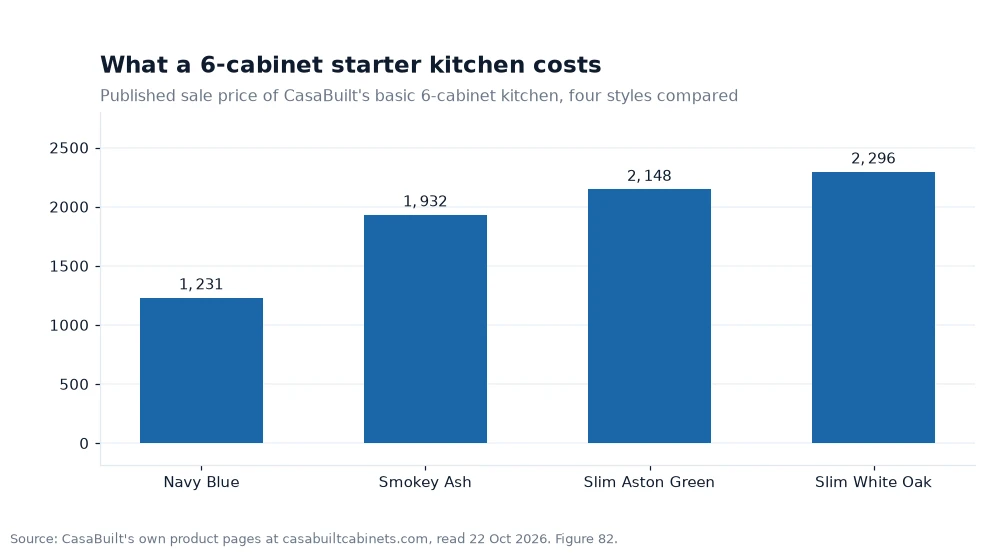
Price is where the finish stops being an abstract preference. CasaBuilt prices a basic kitchen as two base cabinets, two wall cabinets, one tall cabinet and one vanity, and it publishes that bundle in every style. The four styles in the chart below show how much of the total is tied to the coating and the door rather than to the box.
| Style | Sale price | List price | Premium over Navy Blue | Extra per cabinet |
|---|---|---|---|---|
| Navy Blue | $1,230.69 | $2,461.37 | $0.00 | $0.00 |
| Smokey Ash | $1,932.42 | $2,415.52 | $701.73 | $116.96 |
| Slim Aston Green | $2,148.28 | $2,685.36 | $917.59 | $152.93 |
| Oak finish | $2,295.64 | $2,869.56 | $1,064.95 | $177.49 |
The discount depth is not the same across the four. Navy Blue is listed at 50% off, while Smokey Ash, Slim Aston Green and the oak style are listed at 20% off. That is why the gap between Navy Blue and Smokey Ash is larger than the gap between their struck-through prices suggests. A buyer comparing the list prices alone would misread which style is actually the value in the current sale.
Worked example: the premium per cabinet
The chart quotes four sale prices: Navy Blue at $1,230.69, Smokey Ash at $1,932.42, Slim Aston Green at $2,148.28 and the oak finish at $2,295.64. Start with the cheapest. Smokey Ash minus Navy Blue is $1,932.42 minus $1,230.69, which equals $701.73. Slim Aston Green minus Navy Blue is $2,148.28 minus $1,230.69, or $917.59. The oak finish minus Navy Blue is $2,295.64 minus $1,230.69, or $1,064.95.
Divide each difference by the six cabinets in the bundle. $701.73 divided by six is $116.96. $917.59 divided by six is $152.93. $1,064.95 divided by six is $177.49. So the finish decision costs about $177 more per cabinet than the painted blue door, and about $61 more per cabinet than the green one. As a ratio, $2,295.64 divided by $1,230.69 is 1.87, meaning the oak bundle costs 87% more than the Navy Blue bundle.
The list price tells the same story from the other side. $2,869.56 minus $2,295.64 is $573.92, and $573.92 divided by $2,869.56 is 0.20, which matches the published 20% discount. For scale, $1,064.95 divided by the $9.99 sample price is 106.6, so the premium over Navy Blue is worth about 107 sample doors.
Frequently asked questions
Will the oak color turn yellow over time?
Every pale painted finish shifts a little under sustained daylight, and the published UV protective topcoat is there to slow that shift rather than prevent it. Keep the doors out of direct afternoon sun where the layout allows, wipe cooking grease promptly, and store one spare door flat in a dark cupboard so you have a reference point in five years.
Is the door solid oak?
No. The published specification is a rubberwood frame with an MDF panel, painted in seven layers with a UV protective finish, and the name describes the color and finish rather than the timber. The box behind it is 1/2-inch birch plywood with a 3/4-inch solid birch face frame.
What is the safest way to clean a painted oak-look door?
Use a damp cloth with a small amount of mild dish soap, then dry the surface with a soft towel. Avoid abrasive pads, bleach and solvent cleaners, and test anything unfamiliar on the back of a sample door before it touches a cabinet face.
Judge the finish in your own light
Order one door before you order a kitchen. Set it against the floor, the counter and the wall paint, then look at it at seven in the morning and again at seven in the evening, because a pale oak tone changes more across a day than most buyers expect. CasaBuilt sells sample doors at $9.99 and refunds the fee with a cabinet purchase, which makes the test close to free.
If the tone holds up, the rest is arithmetic: count the cabinets, compare the bundle price against the budget, and remember that the premium of $1,064.95 over Navy Blue buys paint depth and a pale palette, not a different box. If it does not hold up, you have learned that for the price of a sandwich.
Figures quoted here come from the manufacturer's own website, read 22 Oct 2026[1].